


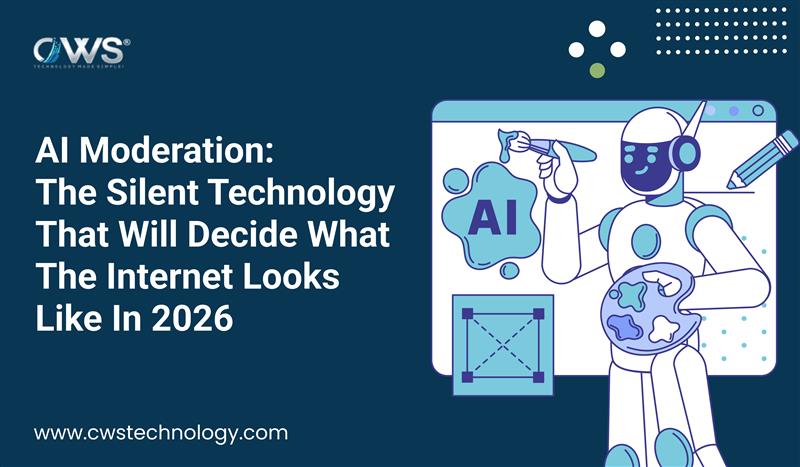
AI moderation is rapidly becoming the invisible force shaping what billions of people read, watch, and share online. As online content reaches unprecedented scale and speed, no human team alone can filter misinformation, hate speech, scams, or harmful media. In 2025, the question is no longer whether AI moderation will influence the internet, but how deeply it will define its future.
This blog explores how AI moderation works, why it is silently shaping digital culture, and what this transformational shift means for platforms, creators, businesses, and everyday users.
What Is AI Moderation and Why It Matters Now
AI moderation refers to the use of machine-learning systems to identify, filter, approve, or block user-generated content across social networks, marketplaces, forums, streaming platforms, messaging apps, and more.
In 2025, nearly every global platform relies on automated content moderation to improve safety, reduce risk, and maintain trust.
Why AI Moderation Is Becoming Unavoidable
- Content volume has exploded
Every minute, millions of posts, comments, images, and videos are uploaded worldwide. Manual moderation alone cannot keep up.
- Online harm is more sophisticated
Threats like deepfakes, phishing schemes, and synthetic disinformation require advanced detection tools.
- Regulations are tightening
Laws such as the EU Digital Services Act and similar global frameworks now require platforms to moderate harmful or illegal content quickly.
- Businesses risk revenue loss
Unmoderated content can lead to advertiser pullouts, user distrust, and reputational damage.
The result: AI moderation is now the silent gatekeeper controlling the flow of online information.
How AI Moderation Works: The Technology Behind the Silence
AI moderation is not a single algorithm but a layered system combining multiple technologies.
1. Natural Language Processing (NLP)
NLP models evaluate text for:
- Hate speech
- Harassment
- Spam
- Misinformation
- Graphic descriptions
- Extremist language
These models understand context, patterns, and sentiment, helping platforms catch nuanced or coded content.
2. Computer Vision
AI scans images and videos to detect:
- Violence
- Nudity
- Weapons
- Graphic content
- Deepfake manipulation
- Copyright infringement
Computer vision models are improving at spotting subtle violations, including altered or intentionally obscured content.
3. Audio and Speech Analysis
Platforms increasingly moderate:
- Live streams
- Voice chats
- Podcasts
- Video captions
AI transcribes speech and flags unsafe or illegal audio segments in real time.
4. Behavioural Pattern Analysis
AI identifies suspicious behaviours such as:
- Bot-like posting
- Fake accounts
- Coordinated disinformation
- Fraudulent transactions
- Mass harassment patterns
This form of moderation focuses not just on content but on the intent and pattern behind it.
AI Moderation Is Not Just a Safety Tool. It Is a Culture-Shaping Tool.
AI moderation decides what stays online and what disappears. This gives platforms immense influence over digital culture.
1. AI Shapes What We See, Believe, and Discuss
When AI removes posts or down ranks certain content, it indirectly influences:
- Public opinion
- Trend cycles
- Political discussions
- Exposure to ideas
- Access to knowledge
These decisions happen silently, with users often unaware of what was filtered out.
2. AI Moderation Impacts Creators and Businesses
Automated moderation systems determine:
- What content gets demonetised
- Which posts have reduced reach
- Which ads are approved or rejected
- Whether products or services are flagged as unsafe
Creators may lose visibility. Businesses may lose ad campaigns. Entire accounts may be restricted.
3. The Rise of Algorithmic Bias Concerns
AI moderation can misinterpret:
- Satire
- Cultural expressions
- Political commentary
- Languages with limited training data
Mislabeling can lead to unfair removals, especially in marginalised communities.
4. AI Moderation and Global Inequality
Moderation standards vary across countries. AI trained primarily on Western datasets may not adapt well to diverse languages or contexts, creating global digital divides.
Top 7 Ways AI Moderation Will Decide the Future of the Internet in 2025 and Beyond
1. Real-Time Filtering of Harmful Content
Live streams and video-first platforms will rely heavily on AI to detect:
- Self-harm
- Violence
- Illegal activities
- Hate speech in real-time
Human moderators will only intervene when AI escalates alerts.
2. Automated Age-Appropriate Experiences
AI will personalise content visibility based on estimated user age, improving child safety across the digital ecosystem.
3. Deepfake and Synthetic Media Detection
Advanced AI will combat AI-generated misinformation at scale.
4. Advertiser-Friendly Safeguards
AI will enforce brand safety standards automatically, deciding which posts qualify for monetisation.
5. Global Compliance With Local Laws
AI will enforce region-specific moderation rules to meet international regulatory demands.
6. Trust Scores for Accounts and Content
Platforms will use AI-driven trust indicators to rank accounts, reducing reach for suspicious users.
7. Personalised Moderation
Users may soon customize what they want filtered, from profanity to political content, giving them more control over their digital space.
Advantages and Disadvantages of AI Moderation
Advantages
- Faster and more scalable than manual moderation
- Reduces exposure of human moderators to traumatic content
- Ensures consistency across content decisions
- Enables real-time responses to harmful content
- Helps platforms comply with legal regulations
Disadvantages
- Risk of false positives and over blocking
- Bias in training datasets
- Lack of transparency in decision-making
- Difficult to adapt to nuanced cultural or contextual situations
- Potential misuse for censorship
Best Practices for Platforms Using AI Moderation
- Combine AI moderation with human review for complex decisions.
- Train models using diverse datasets to reduce bias.
- Provide transparent explanations for moderation actions.
- Offer clear appeal mechanisms for users and creators.
- Update models regularly to address emerging threats.
- Allow users to customize moderation intensity when possible.
Conclusion
AI moderation is no longer just a technical requirement. It is the silent infrastructure determining the safety, culture, and integrity of the global internet. As platforms scale and threats evolve, AI moderation will shape everything from public discourse to creator livelihoods to business operations.
The challenge now is ensuring that AI moderation is transparent, fair, and adaptable so that it enhances—not restricts—the digital freedom and safety of billions of users.