


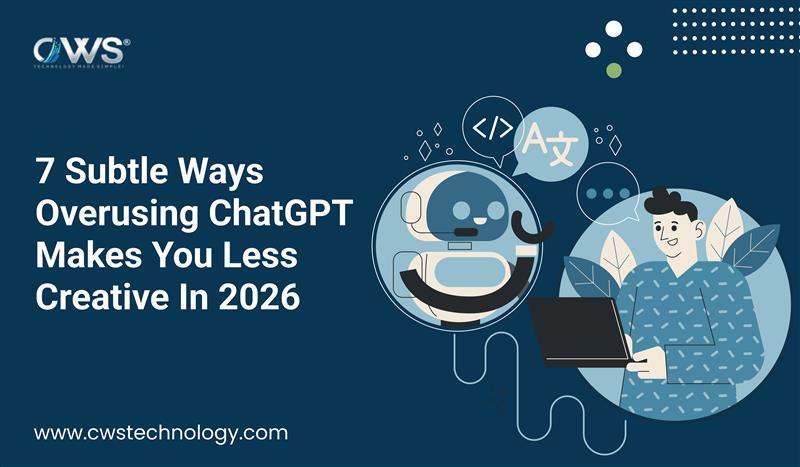
Overusing ChatGPT creativity is becoming one of the quietest threats to original thinking in today’s AI-powered world. While tools like ChatGPT have transformed how we write, code, and brainstorm, excessive dependence can slowly weaken the very creativity we are trying to enhance. In 2026, the real challenge is not whether to use AI—but how to use it without losing your creative edge.
The Double-Edged Sword of AI Creativity
ChatGPT is not the enemy of creativity. In fact, when used intentionally, it can sharpen ideas, reduce friction, and speed up execution. The problem begins when AI stops being a support system and starts becoming a substitute for thinking.
Creativity is not just about producing something quickly. It is about wrestling with ideas, making unexpected connections, and trusting your internal voice. Overuse quietly disrupts that process—often without you realizing it.
1. You Skip the Mental Struggle That Sparks Original Ideas
Creativity rarely arrives fully formed. It emerges from confusion, half-baked thoughts, and uncomfortable pauses. When ChatGPT provides immediate answers, it removes that crucial struggle phase.
Over time, this changes how your brain approaches problems. Instead of exploring possibilities, it learns to wait for solutions.
This typically shows up as:
- Reduced brainstorming time
- Fewer experimental ideas
- A habit of choosing speed over depth
The danger here is subtle. You still get results—but they feel flatter, safer, and less exciting.
Best practice:
Think first, prompt second. Write rough ideas before turning to AI for refinement.
2. Your Thinking Slowly Becomes Predictable
ChatGPT is trained on patterns. When you rely on it repeatedly, those patterns begin to shape your output—and eventually, your thinking.
This doesn’t mean your work becomes bad. It means it becomes familiar.
You may notice:
- Your writing sounds “correct” but uninspiring
- Your ideas resemble what’s already out there
- Your creative risks decrease
For creators, marketers, and writers, predictability is dangerous. Audiences connect with originality, not perfection.
Key insight:
AI-generated ideas should challenge your thinking—not define it.
3. Curiosity Gets Outsourced to Convenience
Curiosity is a creative muscle. It grows stronger when you explore conflicting opinions, read widely, and ask uncomfortable questions. Overusing ChatGPT replaces that exploration with convenience.
Instead of:
- Reading multiple perspectives
- Digging into primary sources
- Sitting with unanswered questions
You receive polished summaries and conclusions.
While efficient, this habit reduces depth. Creativity thrives on curiosity—not conclusions.
Healthy habit:
After every AI-generated response, ask yourself one question:
“What else could be true?”
4. You Start Doubting Your Own Creative Instincts
One of the most overlooked effects of overusing ChatGPT creativity is the quiet erosion of self-trust.
When every idea needs AI validation:
- Decision-making slows
- Confidence weakens
- Fear of being “wrong” increases
This doesn’t happen overnight. It happens gradually—until you hesitate to publish, design, or decide without AI confirmation.
Creativity requires trust. When you stop trusting yourself, originality suffers.
Creative reset tip:
Create AI-free zones in your workflow, such as first drafts or brainstorming sessions.
5. Speed Replaces Depth as the Primary Goal
ChatGPT excels at speed. But creativity is not a race.
When speed becomes the main metric:
- Nuance disappears
- Emotional depth weakens
- Ideas remain surface-level
This is especially visible in content creation. Fast AI-generated content may rank initially, but it often struggles with engagement, retention, and brand authority.
Depth takes time. And time is where creative thinking lives.
Balanced approach:
Use ChatGPT for structure and editing—but reserve core ideation for human thinking.
6. You Lose the Ability to Sit With Boredom
Boredom is uncomfortable—and essential.
Some of the most original ideas appear when the mind wanders freely. Overusing ChatGPT eliminates boredom by filling every gap with instant stimulation.
As a result:
- Imagination weakens
- Mental playfulness declines
- Spontaneous ideas become rare
Historically, creativity has thrived in moments of stillness, not prompts.
Rebuild this skill by:
- Taking walks without devices
- Journaling without structure
- Letting your mind drift intentionally
7. Creativity Becomes Measured by Output, Not Originality
The most dangerous shift happens when creativity becomes transactional.
More blogs. More posts. More lines of code.
But not necessarily better ideas.
When output becomes the only metric, originality loses its value. Creativity turns into production rather than expression.
Ask yourself:
- Does this idea sound like me?
- Would I still create this without AI?
If the answer is no, it’s time to recalibrate.
How to Use ChatGPT Without Losing Creativity
ChatGPT is not the problem—unconscious use is.
Here’s how to maintain a healthy creative balance:
- Start with your own thinking
- Use AI as a collaborator, not a creator
- Question AI outputs instead of accepting them
- Protect time for tool-free ideation
- Measure success by originality, not volume
When boundaries exist, creativity survives.
Conclusion: Creativity Needs Intentional Use of AI
Overusing ChatGPT creativity doesn’t destroy originality overnight. It slowly dulls it—one shortcut at a time.
AI should amplify human thinking, not replace it. The most creative professionals in 2026 will not be the fastest—they will be the most intentional.
Final recommendation:
Use ChatGPT as a tool. Stay human in your thinking.